
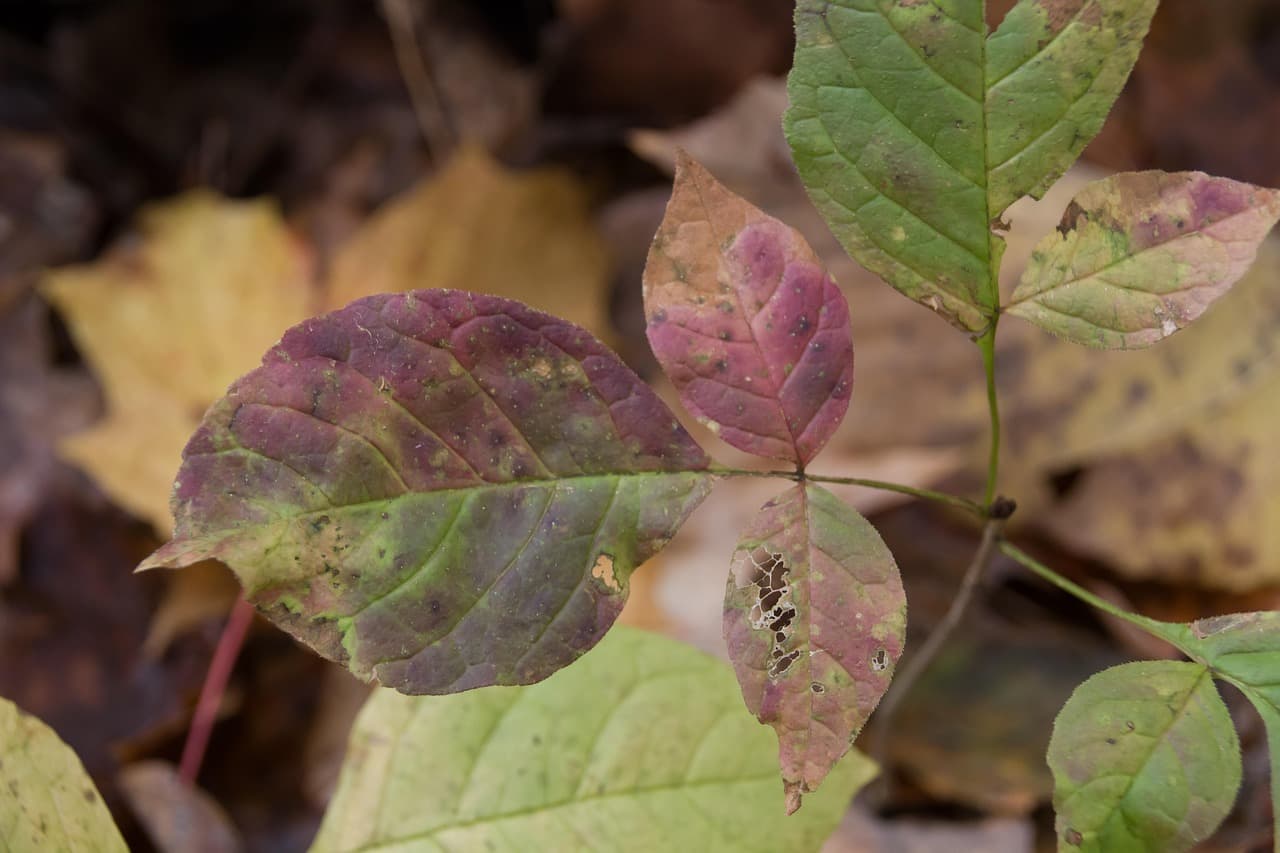
Poison ivy does not go away in winter. The oil that causes the reaction, urushiol, is present in every part of the plant and in every season, including bare winter stems and roots. That is why people sometimes end up with an unexplained rash after pulling brush in December or picking up downed branches in early spring.
Recognizing the plant year-round makes the whole yard safer.
Leaves of three, but it is a little more complicated
The classic rule, "leaves of three, let it be," is correct as a starting point. Poison ivy leaves almost always come in clusters of three leaflets. But those leaflets can vary a lot in appearance:
- Shape ranges from smooth-edged to mitten-shaped to jaggedly toothed.
- Size varies from small immature leaves to leaflets several inches long.
- Color shifts from reddish in spring to deep green in summer to bright red or orange in fall.
- Surface can be glossy or matte depending on age and location.
Because of this variability, it helps to look beyond the leaves.
The aerial rootlets tell you a lot in winter
When mature poison ivy climbs a tree or post, it grows dense, hairy-looking aerial rootlets that hold it to the surface. Those rootlets remain all year and are visible even when the vine is leafless.
A thick vine with a fuzzy or furry texture climbing a tree is one of the most useful winter ID clues, since few other native vines have that same look.
Berries and stems through fall and winter
In late summer and fall, poison ivy often produces small clusters of dull white or grayish berries. Birds eat them and spread the seeds widely, which is part of why the plant shows up in new places each year.
By late winter, leaves are gone, but berries may persist on older vines. A vine with those whitish berry clusters and hairy aerial rootlets is almost certainly poison ivy, regardless of season.
Three common growth habits to watch for
Poison ivy shows up in three general forms in most yards:
- A low groundcover weaving through grass, beds, or woodland edges.
- A climbing vine scaling trees, fences, and outbuildings.
- A shrubby upright form, usually in sunnier, disturbed areas.
Different spots in the same yard can have different forms of the same plant. Checking all three habits when you do a property walk catches more than looking for just one.
Where it tends to show up
Poison ivy is most commonly found at edges, transitions, and disturbed ground:
- Along fence lines.
- Where lawn meets woodland.
- On the sides of stumps or old tree trunks.
- Among overgrown perennials that have not been weeded for a while.
- Near bird feeders or favorite bird perches where seeds get dropped.
Any place that stays partially managed tends to be where poison ivy gets established. That also makes it an argument for keeping edges tidy throughout the year.
Keep reading — start your 7-day free trial.
Premium members read every article in full, save reading lists and project plans, and use the Backyard Project Planner with custom budgets, printable summaries, and shopping lists. Cancel any time during the trial and you pay nothing.
- Finish this article and every other guide in the library
- Save articles and project plans to your account
- Use the full Backyard Project Planner with exact budgets, printable plans, and shopping lists
- Cancel in two clicks — no charge during the trial
No comments yet. Be the first reader to add context, ask a question, or share what happened in your yard.