
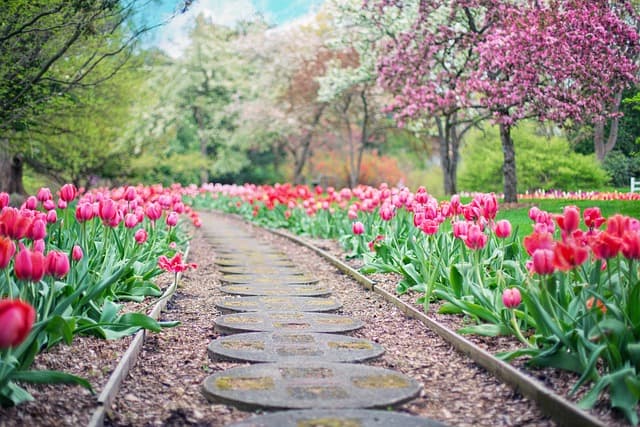
Once the tulips and daffodils finish their show, the bed often looks a little sad. Petals drop, stems flop, and the foliage starts to yellow. The reflex is to tidy it up immediately.
Resist that reflex a little. What happens to the leaves in the weeks after bloom is exactly what determines whether those bulbs come back strong next spring or fade out over time.
The leaves are storing next year's bloom
After flowering, a bulb enters a short window where the leaves are still photosynthesizing and feeding the underground bulb itself. That energy becomes next spring's flowers.
If you cut the foliage while it is still green, you are cutting off next year's show. This is by far the most common reason a bed of tulips or daffodils blooms beautifully the first season, then gradually thins out and stops performing.
Wait until the leaves yellow on their own
The reliable rule is to leave the foliage until it yellows and starts to collapse naturally. That typically takes several weeks after bloom, depending on the species and climate.
Once the leaves are mostly yellow and lift easily, the bulb has finished its job and it is safe to clear the foliage. Before that point, leave it alone, even if it looks untidy.
Do not braid or tie up bulb foliage
An old-fashioned tidy-up technique is to braid tulip leaves or tie daffodil foliage into bundles. It looks neat, but it reduces how much light the leaves can absorb.
The more surface area of leaf that can face the sun, the more energy the bulb stores. Let the foliage sprawl a little. It is not a permanent look.
Deadhead the spent flowers, not the foliage
Removing the spent flower head after bloom is a different task, and it is one that genuinely helps many bulbs.
Once the flower fades:
- Cut the flower stem off just above the first leaf.
- Leave all the leaves untouched.
Removing the flower keeps the plant from spending energy on seed production and directs that energy back into the bulb. This is especially useful with tulips.
Watering after bloom still matters for a while
Keep reading — start your 7-day free trial.
Premium members read every article in full, save reading lists and project plans, and use the Backyard Project Planner with custom budgets, printable summaries, and shopping lists. Cancel any time during the trial and you pay nothing.
- Finish this article and every other guide in the library
- Save articles and project plans to your account
- Use the full Backyard Project Planner with exact budgets, printable plans, and shopping lists
- Cancel in two clicks — no charge during the trial
No comments yet. Be the first reader to add context, ask a question, or share what happened in your yard.